If you search “custom Mylar bags” right now, you will find ten pages written for survivalists storing rice in their basement not for brand owners building a real product business. That content has nothing to do with you.
You are a brand owner. You have a product that needs packaging that protects what is inside, carries your brand identity, meets compliance requirements in every market you sell into, and ships cleanly from your facility to your customer’s hands. This guide is written specifically for you DTC founders, product managers, and packaging buyers who need to understand custom Mylar bags in the context of building a scalable, professional product business.
Everything in this guide is grounded in material science, production reality, and the actual decisions you will face when ordering custom Mylar packaging for the first time or the tenth time.
What Are Custom Mylar Bags for Brand Owners?
Custom Mylar bags are laminated, multi-layer flexible packaging structures engineered to protect your product from oxygen, moisture, light, and odor while carrying full-color custom print on the exterior. The term “Mylar” comes from DuPont’s original polyethylene terephthalate (PET) film developed in the 1950s, but in modern commercial packaging it refers to the complete three-layer laminated structure used across food, cannabis, supplement, coffee, pet treat, and cosmetic categories.
The reason custom Mylar bags dominate so many product categories is not brand preference it is material physics. No other flexible packaging format delivers the same combination of barrier performance, print quality, structural integrity, and regulatory compliance readiness at a comparable unit cost.
What Are the Three Layers of a Custom Mylar Bag and What Does Each One Do?
Understanding the three-layer structure of a custom Mylar pouch is the fastest way to understand why it outperforms every competing flexible packaging material across almost every product category.
The PET Outer Shell is polyethylene terephthalate film a high-performance polyester that gives the bag its structural rigidity, puncture resistance, and ability to hold its shape during filling, transit, and shelf display. This layer is also the print surface. Full-color CMYK printing, Pantone color matching, matte laminate, UV spot coating, and soft-touch finish all live on the PET surface. What your customer sees and touches is entirely determined by the quality of this outer layer. It is the difference between packaging that reads as a $3 product and packaging that reads as a $30 product.
The Aluminum Core is the layer that makes Mylar packaging technically superior to every other flexible format. A thin sheet of aluminum foil bonded between the PET outer and PE inner layers creates what packaging engineers measure as near-zero oxygen transmission rate (OTR) and near-zero water vapor transmission rate (WVTR). In practical terms: oxygen cannot reach your product and oxidize it, moisture cannot penetrate and degrade it, UV and visible light cannot pass through and break down active compounds, and odor cannot migrate inward or outward. Every category that depends on product freshness cannabis, coffee, supplements, snacks, pet treats depends on this aluminum foil layer.
The PE Inner Film is food-grade polyethylene that contacts your product directly. It is FDA-compliant for direct food contact and does not react with your product, alter its flavor, or affect its composition. It is also the heat-seal layer when a filled bag passes through a heat sealer, the PE film melts and fuses at the seam, creating an airtight, tamper-evident closure that locks in everything the aluminum barrier is protecting. The consistency and integrity of your PE layer and your heat-seal parameters is one of the most critical quality variables in custom Mylar bag production. A seal that looks airtight but is not will compromise every protection claim your packaging makes.
What Do Custom Mylar Bags Protect Against That Other Packaging Cannot?
The supply chain is your product’s primary enemy not the customer. Between your production facility and your customer’s hands, your product spends days or weeks exposed to oxygen, fluctuating humidity, UV light, and physical handling stress. Most flexible packaging formats defend against one or two of these variables. Custom Mylar bags defend against all four simultaneously, because of the aluminum barrier layer that no paper, plastic, or standard poly bag can replicate.
Oxygen causes rancidity and potency degradation in virtually every perishable product category. The aluminum core stops oxygen transmission at the molecular level, extending the shelf life of food products, preserving cannabinoid concentrations in cannabis, and maintaining active ingredient potency in supplements – without any change to your formula.
Moisture destroys powder products through clumping and caking, degrades snack texture, causes mold in soft food products, and accelerates oxidation when combined with oxygen exposure. The multi-layer Mylar structure prevents moisture migration in both directions across the life of the package.
Light specifically UV light degrades cannabinoids, oxidizes coffee oils, breaks down photosensitive active ingredients in supplements, and fades color in food products. An opaque Mylar bag blocks 100 percent of light transmission from the moment it is sealed.
Odor migration matters for cannabis compliance, coffee freshness, supplement palatability, and pet treat marketability. The aluminum barrier prevents smell migration both outward and inward – which is why custom Mylar bags are the industry default for smell-proof packaging across regulated and consumer categories alike.
What Are the 6 Custom Mylar Bag Formats and Which One Is Right for Your Product?
Choosing the wrong bag format is one of the most expensive first-order mistakes a brand owner can make in packaging. The format determines how your bag fills, how it ships, how it stands on shelf, and how your customer interacts with it after purchase.
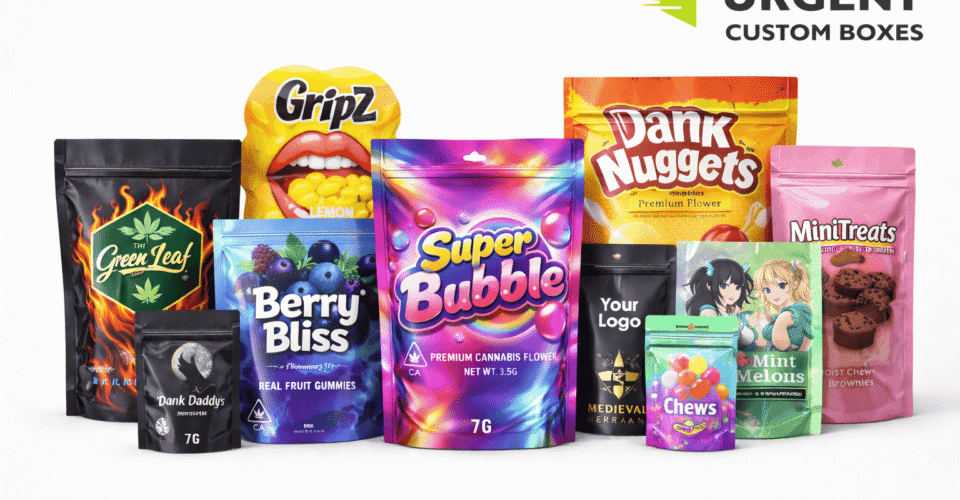
Stand-Up Pouches are the most widely used custom Mylar format across retail-distributed brands. A gusseted bottom allows the bag to stand independently on a shelf without support, giving your design team maximum front-panel real estate and your retail buyer a clean, professional shelf presence. Stand-up pouches are the right choice for food, cannabis flower, pet treats, supplement blends, and any product that sells through retail, dispensary, or grocery channels.
Flat Seal Bags are the most economical Mylar format sealed on three or four sides with no gusset. They lie flat, store efficiently, and work well for samples, single-serve formats, sachets, and products that ship inside a box or mailer where independent shelf display is not required. When your distribution model does not require a self-standing bag, flat seal bags deliver the same barrier performance at a lower per-unit cost.
Gusseted Bags expand outward when filled, creating larger interior volume than a flat bag while maintaining a more controlled shape than an overstuffed flat pouch. Side-gusseted or bottom-gusseted Mylar bags are the right format for high-volume fills bulk snacks, pound bags, family packs, or multi-serve products. Because they hold their shape at large fill weights and create consistent, predictable package dimensions that simplify cartonization and palletization.
Child-ResistantMylar Bags use specialized zipper closure systems typically press-to-close pinch-and-slide mechanisms certified to ASTM D3475 standards. These are a legal requirement in virtually every U.S. legal cannabis market and are increasingly mandated in pharmaceutical-adjacent supplement categories. ASTM D3475 certification is not an upgrade option – it is a compliance threshold. Non-compliant packaging in cannabis markets results in product recalls, regulatory fines, and license risk that far exceeds any cost savings from using non-certified closures. All child-resistant Mylar bags at Urgent Custom Boxes use ASTM D3475-certified closures.
Clear and Window Bags incorporate a transparent front panel or full-transparency structure that allows customers to see the product before purchase. This format trades partial barrier performance in the transparent zones for strong retail impact in visually compelling product categories – premium flower, colorful gummies, whole-ingredient snacks, and artisan products. A window bag is a brand promise: you are communicating that your product looks exactly as it should, every time. Use this format only if your product delivers on that promise with complete consistency.
Die-Cut and Shaped Bags are custom-silhouette Mylar structures cut into irregular or brand-specific shapes – mascot forms, logo silhouettes, or category-distinctive outlines. They are the highest visual-impact format available and exist specifically to create shelf differentiation, memorability, and social shareability. The production cost is higher than standard formats because of die tooling and material complexity, but in the right category – exotic cannabis, novelty snacks, limited-edition drops – that cost replaces marketing spend. A bag that customers photograph and share is doing customer acquisition work.
What Mylar Bag Thickness, Size, and Finish Should You Specify for Your Product?
These three specification decisions are where first-time brand owners make the most expensive mistakes – and where getting it right saves money across every order you place.
Thickness is measured in mils thousandths of an inch. The correct thickness for your product is determined by your barrier requirements, your fill weight, your distribution conditions, and your target shelf life not by which option costs the least per unit.
3 to 3.5 mil bags are appropriate for light retail fills, sample formats, and products with shelf cycles of 30 to 60 days. 4 to 5 mil bags cover the majority of food, supplement, and CPG applications targeting 3 to 6 months of shelf life. 7 mil bags are the specification for demanding applications: cannabis flower, premium coffee, bulk supplements, and any product where barrier failure creates a compliance problem, a brand quality problem, or a customer return. The cost difference between 3 mil and 7 mil across a production run is smaller than the cost of a single customer complaint about product arriving stale or degraded.
Size is determined by three variables: your product’s fill weight in grams or ounces, your product’s fill density (loose-fill, dense-packed, powder, or solid. Same weight fills very different volumes), and your target shelf footprint – how the filled bag needs to sit, stand, or display. A bag sized on estimated volume rather than actual fill parameters will arrive either overpacked and distorted or half-empty and floppy on shelf. Neither is acceptable. Bring your product, your fill weight, and your target shelf format to your packaging supplier and size from there – not from a standard chart.
Finish is a brand communication decision with measurable impact on how customers perceive your product’s price point and quality tier before they read a single word of copy.
Gloss laminate produces high shine and color saturation under retail lighting. It is the finish associated with mass-market products – bold, energetic, and accessible. It performs well for impulse-purchase categories and value brands.
Matte laminate produces a flat, light-absorbing surface that communicates restraint, craft, and premium positioning. Matte has become the default finish across craft cannabis, specialty coffee, and premium supplement brands because it signals quality through visual understatement.
Soft-touch laminate is a velvet-textured coating that creates a sensory premium experience the moment a customer picks up the bag. It costs more than standard matte but signals luxury at the point of touch in a way no printed surface alone can replicate. Used on hero SKUs, limited editions, or reserve lines, soft-touch is one of the highest-ROI finish upgrades available in custom Mylar packaging.
UV spot coating applies a high-gloss varnish to specific design elements on an otherwise matte surface – a wordmark, a logo mark, or a hero graphic – creating visual contrast that makes your brand identity stand out against the flat field around it. Buyers notice it without knowing what they are looking at. They just know the bag looks more expensive than everything next to it.
Which Industries Require Custom Mylar Bags and What Does Each One Need?
Cannabis Brands face the most technically demanding Mylar application because regulatory compliance requirements layer directly on top of product-protection requirements, and both vary by state market.
Cannabis Mylar packaging must include child-resistant closures certified to ASTM D3475 – this is mandatory across virtually every U.S. legal market. Full opacity is required by most state regulations, which the standard aluminum barrier structure provides by default. The multi-layer barrier controls odor both for customer experience and regulatory compliance. Label surface area must accommodate compliance copy – THC percentages, batch numbers, health warnings, regulatory statements alongside your brand design. SKU scalability matters in dispensary environments where dozens of products compete on the same shelf; brands that win do so through consistent structural format across strains combined with clear visual differentiation in color and artwork.
Urgent Custom Boxes produces cannabis Mylar bags in 3.5g, 7g, half-ounce, 1oz, and pound formats. All with certified child-resistant closures and full custom printing.
Food and Snack Brands use custom Mylar to accomplish three simultaneous goals: protecting product freshness, extending shelf life, and presenting competitively on retail shelves. The specific barrier priority depends on the product – moisture barrier for crackers, dried fruit, and grain-based snacks; oxygen barrier for nuts, seeds, and oil-containing products; full opacity for light-sensitive items. Resealable zipper closures on stand-up pouches allow consumers to open, use, and reseal without losing the barrier integrity they are paying for through the price of the product.
Coffee Brands have a packaging requirement no other category shares: freshly roasted coffee produces CO2 for days after leaving the roaster, and sealing fresh-roasted beans in a standard Mylar bag without a degassing valve creates pressure buildup that can compromise both the seal and the flavor. A one-way degassing valve – a pressure-relief mechanism laminated into the bag – allows CO2 to exit while preventing oxygen from entering. This is not an optional feature for coffee brands packaging within 24 to 72 hours of roast. It is a fundamental format requirement. Beyond the valve, coffee Mylar bags typically use side-gusset or flat-bottom formats for bulk fills, resealable zippers for whole-bean convenience, and matte or kraft-style finishes for specialty and artisan brand positioning.
Supplement and Powder Brands face two primary challenges: FDA compliance requirements and the hygroscopic nature of powder-based products. The PE inner film meets FDA standards for direct food contact, and Mylar itself is food-contact safe. Label content, claims language, and Supplement Facts panels must comply with FDA dietary supplement labeling regulations – that is the brand owner’s responsibility, not the packaging supplier’s. Moisture sensitivity is the primary technical challenge. Protein powders, pre-workouts, and greens blends absorb ambient humidity aggressively, and even small amounts of moisture infiltration cause clumping, caking, and degraded mixability. Heavy-gauge Mylar 5 to 7 mil with strong heat seals and appropriate desiccant management is the standard specification for powder supplement applications.
Pet Treat Brands have become one of the most sophisticated custom Mylar packaging verticals, driven by premium positioning, DTC subscription growth, and increasingly brand-conscious pet owners who make purchase decisions the same way they make decisions for their own food. Soft treats require moisture control to prevent mold. Crunchy treats require moisture exclusion to maintain texture. Strong aromatic profiles in pet treats make full Mylar barrier important for odor containment during shipping. DTC pet brands need packaging that performs both as product protection and as a brand moment at the point of delivery – resealable closures, premium finishes, and thoughtful design all contribute to the unboxing experience that drives reviews and social sharing.
Cosmetic and Beauty Brands increasingly use custom Mylar in place of folding cartons for sample formats, travel-size products, sheet masks, single-dose serums, and powder-based cosmetics. Mylar provides equal or superior barrier protection at lower unit cost and weight, with full-color print quality that matches or exceeds what folding cartons achieve. Soft-touch matte is the dominant finish choice in premium beauty applications. It communicates luxury through tactile experience in a way no printed paper carton can replicate.
How Do Print Options Affect the Final Look of Custom Mylar Bags?
CMYK printing uses four ink channels cyan, magenta, yellow, and black to reproduce a full color spectrum. It is the right choice for complex, photographic, or multi-color artwork and is cost-effective across standard production volumes. Color accuracy can shift between print runs without careful management, so specifying confirmed CMYK values for all brand colors is essential.
Pantone matching uses proprietary ink formulas to reproduce specific, precisely defined colors with consistency across every order, every supplier, and every format. If your brand has defined Pantone references, specify them. Consistent color management across your packaging system is a brand equity asset – not a production detail. Urgent Custom Boxes matches Pantone references as standard practice.
Spot color printing uses pre-mixed ink for specific design elements that cannot be reproduced through CMYK. Metallic gold, silver, and copper being the most common examples. If your design includes metallic elements, specify them as spot colors from the start of the artwork process, not as a revision after proofing.
Water-based inks are the production default at Urgent Custom Boxes – lower VOC emissions, safer for workers, and better aligned with sustainability commitments without sacrificing color quality for standard applications. Solvent-based inks produce higher saturation on certain specialty substrates and are used where the technical requirements of a specific design or surface treatment make them the right choice.
What Should You Have Ready Before Ordering Custom Mylar Bags?
The most common reason custom Mylar bag orders get delayed is that brands arrive at the conversation before they have made the decisions a packaging supplier needs to move forward. Having these elements ready before your first conversation eliminates the most common revision cycles and gets you to a production-ready proof faster.
Your fill weight and product dimensions need to be actual numbers not estimates. The difference between 7g and 10g changes bag dimensions, fill margins, and seal area in ways that affect both function and cost. Bring your product’s fill weight in grams or ounces, the approximate volume of a filled unit, and the density characteristics of your product loose-fill, dense-packed, powdered, or solid.
Artwork files for production require vector files to be AI, EPS, or PDF with fonts outlined for all logos, wordmarks, and text elements. Color specifications must include Pantone references for all brand colors or confirmed CMYK values if Pantone is not specified. All background artwork must extend 3 to 5mm beyond the cut line as bleed. Critical elements including text and logos must stay at least 5mm inside the safe zone. High-resolution raster images must be at 300 DPI minimum at final print size – not scaled up from web graphics or social media assets.
If you do not have production-ready artwork, the design team at Urgent Custom Boxes builds bag layouts from your brand guidelines. Share your logo, color references, and design direction. We build the layout and provide a digital proof before anything goes to production.
MOQ and lead time at Urgent Custom Boxes are structured to work for growing brands. Standard stand-up pouches with straightforward print specifications start at 500 units. Complex formats with soft-touch laminate, UV spot coating, die-cut structures, or multi-color specialty finishes typically require 1,000 to 2,000 units due to tooling and setup costs. Lead time is primarily driven by design approval – clean, production-ready artwork on the first submission is the single biggest factor in reducing the time from order to delivery. Multiple SKUs on the same bag structure can often be grouped for volume pricing; discuss this with our team if you are launching across multiple strains, flavors, or product lines.
Frequently Asked Questions
What is the minimum order quantity for custom Mylar bags?
Standard stand-up pouches with straightforward print specifications start at 500 units at Urgent Custom Boxes. More complex formats soft-touch laminate, UV spot coating, die-cut shapes, or certified child-resistant closures with specialty zipper systems – typically start at 1,000 to 2,000 units because of tooling and production setup requirements. Multiple SKUs on the same bag structure can often be grouped under a shared volume tier. Contact our team with your format requirements and target volume for a specific MOQ on your configuration.
How long does production take for custom Mylar bags?
Production lead time at Urgent Custom Boxes is typically 10 to 18 business days after artwork approval, depending on format complexity, print specifications, and current production scheduling. The single biggest variable is design approval brands that submit production-ready artwork on the first round move to production immediately. Brands that go through multiple revision cycles add time at every stage. A clean brief and complete artwork file on day one is the fastest path to your bags.
Are custom Mylar bags food-safe?
Yes. The PE inner film that contacts your product directly is FDA-compliant and food-safe. It does not react with your product, alter its flavor, affect its texture, or change its composition. All Mylar bags produced by Urgent Custom Boxes use food-grade PE inner film as standard.
What file format is required for custom Mylar bag artwork?
Vector files AI, EPS, or PDF with fonts outlined are required for all logos, wordmarks, and text elements. All Pantone or confirmed CMYK color values must be specified. High-resolution raster elements must be at 300 DPI at final print size. Background artwork must include 3 to 5mm bleed. If your files are not production-ready, our design team builds the layout from your brand guidelines and delivers a digital proof for approval before production begins.
Can I order multiple SKUs on the same bag structure?
Yes – and it is often the most cost-efficient approach for brands launching across strains, flavors, or product lines. Same format, same structure, different artwork per SKU. Multiple SKUs on a shared structure can frequently be grouped into a single volume pricing tier. Discuss your full SKU lineup with our team before placing your first order.
Do custom Mylar bags meet cannabis compliance requirements?
Our child-resistant Mylar bags use closures certified to ASTM D3475 standards. The standard aluminum barrier structure meets opacity requirements across all state markets. However, label content – THC percentages, health warnings, batch numbers, regulatory statements, and market-specific compliance copy — is the brand owner’s responsibility to verify against the specific requirements of each state or market you sell into. We produce the bag. Your regulatory team confirms the label.
What is the difference between 3 mil and 7 mil Mylar bags?
Thickness in mils thousandths of an inch determines barrier strength, structural feel, seal integrity, and unit cost. 3 to 3.5 mil bags are appropriate for light retail fills with shelf cycles of 30 to 60 days. 5 mil covers the majority of food, supplement, and CPG applications targeting 3 to 6 months. 7 mil is the specification for cannabis, premium coffee, bulk supplements, and any application where barrier failure creates a compliance problem or a brand quality problem. The cost difference per unit between 3 mil and 7 mil across a standard order is smaller than the cost of a single customer complaint about product arriving degraded.
Can Urgent Custom Boxes match my exact brand colors?
Yes. We match specific colors using Pantone references, brand guidelines, or physical samples. Consistent color management across your full packaging system – across SKUs, formats, and reorder cycles – is part of our standard production process, not an upgrade option.
Your Brand Deserves Packaging That Works as Hard as Your Product Does
You have built something worth selling. You have developed a product, refined the formula, established distribution, and created a brand identity worth putting on a bag. The custom Mylar packaging you put that brand on is the first physical thing your customer interacts with – and in a three-second retail decision environment, it is doing more communication work than any other single element of your brand.
Custom Mylar bags, specified correctly and produced at quality, protect what is inside from the supply chain’s four primary threats, carry your brand identity across every SKU and every channel, and arrive in your customer’s hands in the same condition they left your facility. That is not a claim it is what the material does when the specification is right and the production is clean.
At Urgent Custom Boxes, we build custom Mylar packaging for brand owners. Not preppers. Not hobbyists. Businesses that need packaging that performs on shelf, in transit, at the moment of opening, and in the customer’s memory after the product is gone.