
Most packaging manufacturers were not built for small businesses. They were built for companies ordering 10,000 units at a time, with in-house designers, dedicated procurement teams, and warehouse space to store months of inventory. If you are running a small brand, a startup, or a home-based business, that system has never worked in your favor. The good news is the industry shifted, and low minimum order quantity packaging is now a real option. This guide covers what it actually costs, what you need to prepare, and how the process works from first contact to delivery.
Why the Old MOQ System Locked Out Small Businesses
Traditional offset printing requires metal printing plates, one for each color in your design. A four-color box needs four plates. Those plates cost money to produce, and that cost only makes financial sense when it is spread across thousands of units. That is why manufacturers set minimums at 1,000, 5,000, or 10,000 boxes. It was not arbitrary. The economics of offset printing at low volumes simply did not work.
The problem for small businesses was not just cost. It was inventory. Ordering 5,000 mailer boxes when you are shipping 200 orders a month means you are storing roughly two years of packaging inventory. That is warehouse space, tied-up cash, and a serious problem if you update your logo, change your product dimensions, or want to run a seasonal design before the first batch runs out.
What Changed: Why Low MOQ Is Now Possible
Digital printing removed the plate requirement entirely. Instead of etching colors onto metal plates and pressing them onto board, digital printing works like a high-resolution commercial printer, applying ink directly to the substrate. There are no setup plates, which means there is no cost that needs to be spread across a large print run to be financially viable.
This one change restructured the economics of short-run packaging. A supplier running digital presses can print 50 boxes for you at a reasonable unit cost because their setup time is minimal. The trade-off is that digital printing has a higher cost per unit than offset at large volumes. At 500 units, offset wins on price. At 50 to 100 units, digital is the only method that makes sense for both the supplier and the buyer.
Most suppliers offering genuine low MOQ packaging, meaning orders starting at 25 to 100 units, are running digital presses. When a supplier offers no minimum or very low minimum orders, that is the technology making it possible.
What Box Types Are Available in Small Quantities
Not every packaging format is equally accessible at low order volumes. Here is what is realistically available for small batch orders:
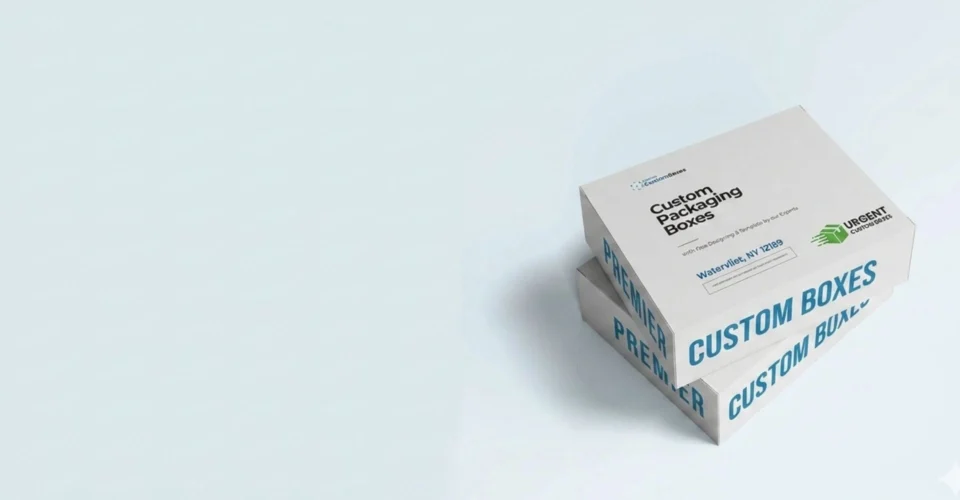
Custom mailer boxes are the most widely available in small quantities. Nearly every low-MOQ supplier offers them, and they work for e-commerce, subscription boxes, and DTC shipping. Most start at 25 to 50 units.
Folding cartons, including tuck-top and auto-bottom styles, are available in small quantities from digital print suppliers. These are the standard retail product boxes used for cosmetics, candles, food items, and supplements.
Custom rigid boxes are available at low MOQ but the floor is typically higher than folding cartons or mailers, usually 50 to 100 units minimum. Because rigid boxes require manual assembly and thicker materials, the economics still favor slightly higher minimums even with digital printing.
Custom Mylar bags are available in small runs, typically starting at 100 units, depending on the supplier and the barrier film specification required.
Corrugated shipping boxes in fully custom print are harder to access at very low quantities because the tooling for die-cut corrugated is more expensive to set up. At 50 units, a custom corrugated shipper is either very expensive per unit or simply not offered. A practical alternative is a standard size corrugated outer with a custom branded insert or label inside.
How Much Does Small Batch Custom Packaging Actually Cost
The per-unit cost at low order volumes is higher than bulk, and it is important to go in knowing the real numbers rather than being surprised at the quote stage.
For custom mailer boxes ordered at 50 to 100 units, expect to pay $2.50 to $5.00 per unit depending on size, board grade, and print coverage. The same box at 1,000 units drops to $1.00 to $2.00 per unit.
For folding cartons at 100 to 250 units, expect $1.50 to $3.50 per unit for standard formats with full-color print. Add soft-touch lamination or spot UV and you are looking at $3.00 to $5.00 per unit at these volumes.
For custom rigid boxes at 100 units, expect $6.00 to $15.00 per unit depending on size, chipboard thickness, and finishing. Magnetic closure boxes sit at the higher end of that range.
Setup fees are a separate line item many first-time buyers do not expect. These cover die-cutting tools or structural templates specific to your box dimensions. At low MOQ suppliers, setup fees range from $100 to $400 and are typically charged once. If you reorder the same box size, you do not pay the setup fee again.
The honest calculation for a small business is this: at 100 units, your total packaging investment including setup might run $400 to $700 for mailer boxes or $800 to $1,800 for rigid boxes. That is real money for an early-stage brand. But compare it to a $3,000 to $6,000 minimum order at a traditional bulk supplier for boxes you may not sell through for 18 months. The cash flow argument for small batch ordering is strong.
A practical budgeting rule: plan to spend 5 to 15 percent of your product retail price on packaging. A product that sells for $35 can support $1.75 to $5.25 in packaging cost per unit. If your packaging cost sits above that range, it will compress your margin more than most early-stage brands can absorb.
What You Need to Prepare Before You Place an Order
This is where most first-time packaging buyers lose time. Going to a supplier without the right assets adds one to two weeks to your timeline and sometimes requires paying for design services you did not budget for.
Product dimensions are the starting point. You need the exact length, width, and height of your product, including any secondary items going in the box such as inserts, tissue paper, or a card. Suppliers use these to create or confirm the box dieline. If your dimensions are approximate, your box will not fit properly, and a remake adds cost and time.
A dieline is the flat structural template that shows every panel, fold line, and cut line of your box. Your artwork goes on top of the dieline. If you have a designer, they need the dieline file before they start. Most suppliers provide dielines for free once you confirm your box dimensions and style. You cannot design packaging artwork without one.
Artwork files need to be print-ready. That means vector files in Adobe Illustrator format or high-resolution PDF, minimum 300 DPI for any raster images, all colors converted to CMYK, and all fonts outlined. RGB files look different when printed, and low-resolution images look blurry on a physical box in a way that is not obvious on screen. If your designer has only worked in digital, they need to know these print specifications before they build the file.
If you do not have a designer, most low-MOQ packaging suppliers offer free or low-cost design support. Some build it into the quote. Clarify this upfront before assuming design help is included.
The Ordering Process from Quote to Delivery
Step one is the quote. Provide your box type, dimensions, quantity, material preference, and any finishing you want such as matte lamination or spot UV. A good supplier comes back with a quote within one to two business days. If you get a quote that requires a phone call before any pricing is revealed, that is a signal their process is not built for small business buyers.
Step two is the dieline. Once you confirm the quote, the supplier sends you a dieline template matched to your box dimensions and style. This goes to your designer to build the artwork.
Step three is artwork submission and proofing. You submit your print-ready artwork file. The supplier runs a prepress check covering resolution, bleed lines, color mode, and margin safety. They come back with either approval or specific revision requests. After prepress approval, you receive a digital proof showing how your artwork sits on the box. Review this carefully. Check that your logo is not sitting too close to a fold line, that text is not running into a cut edge, and that colors look correct in CMYK. Once you approve the proof, production begins. Changes after proof approval add cost and time.
Step four is production. For digital print short runs, production typically takes 7 to 15 business days depending on the supplier’s queue and the complexity of the order.
Step five is shipping. Add 3 to 7 business days for domestic US delivery on top of production time. Rigid boxes are shipped assembled and take more space, which affects freight cost. Folding cartons and mailer boxes ship flat, which keeps shipping cost down.
Total realistic timeline from first contact to boxes in hand: 4 to 6 weeks on a standard order. If your product is launching in 3 weeks, you need a supplier with a confirmed rush production option and you need your artwork ready on day one of the process.
When Low MOQ Custom Packaging Makes Business Sense
You are launching a new product and do not yet know how fast it will sell. Ordering 100 units to test the market is smarter than committing $4,000 to packaging before you have validated demand.
You are testing a new packaging design before scaling. Brands that update packaging frequently, whether for new SKUs, seasonal runs, or a rebrand, cannot afford to be stuck with 3,000 units of an outdated box. Small batch ordering keeps your design agile.
You are running a limited edition or seasonal product. A holiday gift set or a limited-edition colorway with custom packaging creates urgency without requiring you to order a year’s worth of boxes.
You are in an early-stage DTC brand where cash flow matters more than per-unit savings. Spending $600 on 100 boxes you will use in 60 days is better for your business than spending $3,000 on 1,000 boxes that sit in your living room for eight months.
You are an Etsy seller or small-volume maker who ships 50 to 150 orders a month and needs professional branded packaging without committing to quantities that do not match your volume.
When You Should Order in Bulk Instead
Low MOQ ordering is not always the right answer. If your product design is locked and you are consistently shipping more than 500 orders per month, the per-unit savings from bulk ordering add up quickly and the math shifts in favor of a larger run.
At 1,000 units, a mailer box that costs $3.50 per unit in a 100-unit run drops to around $1.25. At 5,000 units on offset, it can drop below $0.80. If you are shipping 600 boxes a month, the difference between paying $3.50 and $1.25 per unit is $1,380 saved every month. At that volume, ordering in bulk and managing the inventory becomes the financially responsible decision.
The crossover point for most small businesses is somewhere between 500 and 1,000 units. Once you are reordering the same packaging configuration every one to three months, talk to your supplier about what a larger run costs and run the numbers honestly.
Frequently Asked Questions
Do I need a designer to order custom packaging?
Not necessarily. Most low-MOQ suppliers have free design support available, and some have online design tools where you can place your logo and choose colors without external design software. If your packaging is structurally simple, a mailer box with a logo and a brand color, a supplier’s in-house team can handle it. If you want something more polished, a freelance packaging designer who understands print specifications is worth the cost of one to two hours of work.
Will small batch custom packaging look as professional as bulk-printed packaging?
For most box types, yes. Digital printing quality has improved significantly and is more than adequate for e-commerce and retail packaging at standard viewing distances. Where you may notice a difference is in very fine metallic finishes or highly saturated Pantone colors, which can be more accurately reproduced by offset at high volumes. For most small business packaging applications, digital print output is professional and consistent.
What happens if I receive the boxes and something is wrong?
Confirm the supplier’s remake policy before you order. Reputable low-MOQ suppliers will reprint at no cost if the error is on their side, meaning a production defect, color shift from the approved proof, or structural fault. If the error is in the artwork you approved, the reprint cost is typically yours. This is why reviewing the digital proof carefully before approval matters.
Can I order different designs on the same box structure at a low quantity?
Some suppliers allow versioning, printing two or three different artwork designs on the same box structure within one order run. This is useful if you have multiple SKUs that share the same box size but need different labels or designs. Not all suppliers offer this. Ask specifically before assuming it is available.
The Bottom Line
Custom packaging with no minimum order requirement exists, it works, and the quality is good enough for a professional brand at any stage. The per-unit cost is higher than bulk, the process takes preparation, and the timeline requires planning. None of that is a reason to avoid it. For a small business that needs to look established without the financial risk of a large inventory commitment, small batch custom packaging is one of the most practical branding investments available.
Urgent Custom Boxes works with small businesses, startups, and growing brands at order quantities that match where you actually are, not where a manufacturer needs you to be. Request a quote with your product dimensions and we will come back with real pricing and a clear timeline.